Trang chủ
Sáu bước xây dựng kho thông minh: Từ tư vấn và lập kế hoạch đến hỗ trợ 24/7
 2026-10-10
 1
1
Hơn 100 dự án đã được triển khai, 63.000 m2 không gian kho được bàn giao, sáu lĩnh vực ứng dụng chính và phạm vi dịch vụ trên khắp năm khu vực trên toàn thế giới — STORIN kết hợp quy trình giao hàng được tiêu chuẩn hóa với bốn lớp hỗ trợ sau bán hàng để đưa tự động hóa kho vào cuộc sống.
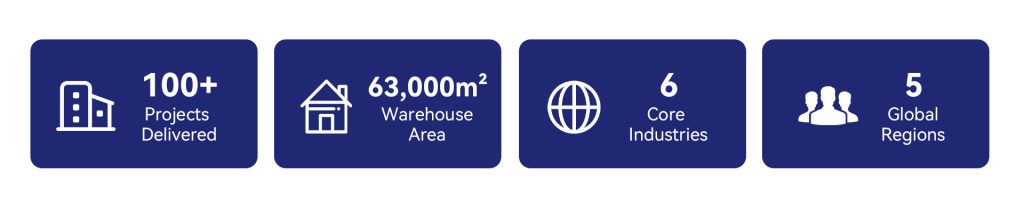
STORIN là nhà tích hợp hệ thống kho bãi thông minh, cung cấp các dịch vụ toàn diện từ tư vấn và lập kế hoạch đến phân phối hệ thống. Cho đến nay, chúng tôi đã giúp triển khai hơn 100 dự án và quản lý hơn 63.000 m2 không gian nhà kho, phục vụ sáu ngành công nghiệp cốt lõi ở 5 khu vực trên toàn thế giới.
Trong toàn ngành, vấn đề tương tự vẫn tiếp tục xảy ra: thiết bị đã được mua nhưng hệ thống vẫn không hoạt động.
Thông số kỹ thuật của thiết bị nêu rõ một AGV có thể chở bao nhiêu, tốc độ di chuyển của tàu con thoi và giá đỡ cao bao nhiêu. Tuy nhiên, sự thành công của một dự án kho bãi thông minh thường phụ thuộc vào việc nhà tích hợp có thể cung cấp dự án và hỗ trợ dự án về lâu dài tốt đến mức nào. Giải pháp có đáp ứng được nhu cầu vận hành thực tế không? Các hệ thống có thể kết nối và làm việc cùng nhau không? Và ai sẽ chịu trách nhiệm bảy ngày—hoặc 100 ngày—sau khi hệ thống đi vào hoạt động?
Trong bài viết này, chúng tôi sẽ giải thích cách chúng tôi đáp ứng các nhu cầu ứng dụng khác nhau, hỗ trợ phân phối dự án và cung cấp dịch vụ hậu mãi.
01 | Sáu ứng dụng chính: Từ tự động hóa các nhiệm vụ riêng lẻ đến Kho thông minh được tích hợp đầy đủ.
Kho thông minh không phải là giải pháp phù hợp cho tất cả. Thương mại điện tử, dược phẩm, hoạt động ô tô và công nghiệp cũng như sản xuất điện tử đều có hồ sơ SKU, làn sóng xử lý đơn hàng, điều kiện địa điểm và cơ cấu nhân sự khác nhau. Đó là lý do tại sao chúng tôi không cung cấp giải pháp giống nhau cho mọi khách hàng. Chúng tôi bắt đầu với cách sử dụng thực sự của từng nhà kho, sau đó chọn sự kết hợp phù hợp giữa hệ thống và thiết bị để đáp ứng nhu cầu của kho đó.
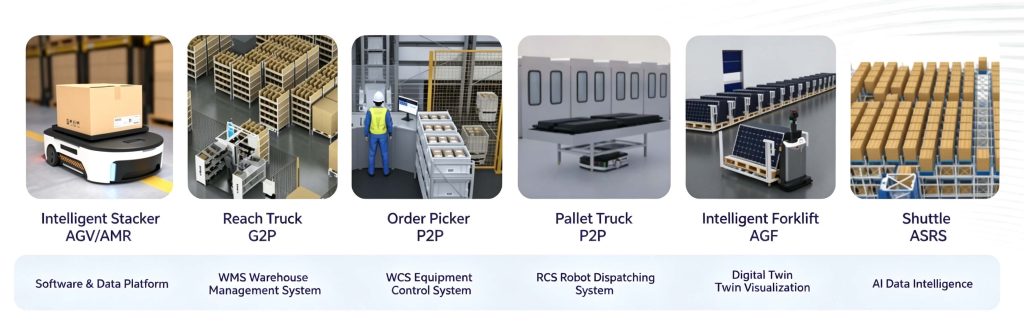
1. Xử lý vật liệu thông minh: AGV/AMR
Các rô-bốt di động—bao gồm các mô hình xe nâng, xe nâng và xe nâng— đảm nhận việc vận chuyển thủ công và di chuyển hàng hóa giữa các khu vực khác nhau. Chúng phù hợp với các hoạt động có nhiệm vụ vận chuyển thường xuyên và các tuyến đường tương đối cố định. Đây là một trong những điểm khởi đầu phổ biến nhất cho tự động hóa kho hàng, mang lại khoản đầu tư có thể quản lý được và mang lại kết quả rõ ràng.
2. Từ hàng hóa đến con người: G2P
Robot nâng hoặc vận chuyển toàn bộ giá đỡ đến các trạm lấy hàng, đưa hàng hóa đến cho người vận hành thay vì bắt người vận hành phải đi bộ đến chỗ hàng hóa. Rất phù hợp với các kho thương mại điện tử và bán lẻ có nhiều SKU và đơn hàng rời rạc, phương pháp này mang lại một số lợi ích đáng chú ý nhất về hiệu quả lấy hàng.
3. Bin-to-Person: B2P
Robot sử dụng các thùng lưu trữ làm đơn vị xử lý, mang các thùng đựng cần thiết đến trạm làm việc. Cách tiếp cận này phù hợp với các hoạt động có nhiều loại sản phẩm, lô nhỏ và lưu trữ tote mật độ cao, cân bằng hiệu quả lưu trữ với hiệu quả lấy hàng.
4. Từ pallet tới người: P2P
Hàng hóa được xử lý bằng pallet, có hệ thống băng tải đưa toàn bộ pallet đến các trạm làm việc. Cách tiếp cận này phù hợp với các kho phân phối vận chuyển toàn bộ thùng hàng và xử lý khối lượng xuất nhập khẩu lớn.
5. Xe nâng tự động: AGF
Xe nâng không người lái xử lý việc vận chuyển pallet, cất giữ và bốc dỡ xe tải, thay thế thao tác thủ công trong các nhiệm vụ liên quan đến nâng ở độ cao và di chuyển tải nặng. Chúng đặc biệt hữu ích trong môi trường lạnh hoặc bụi bặm, không thích hợp cho công việc thủ công kéo dài.
6. ASRS dựa trên tàu con thoi
Four-way shuttles work with multi-level racking to create a high-density automated storage and retrieval system, maximizing storage capacity within a limited footprint. This approach suits projects that require both efficient use of floor space and high throughput.
02 | Software and Data Platform: Making Equipment Work Together.
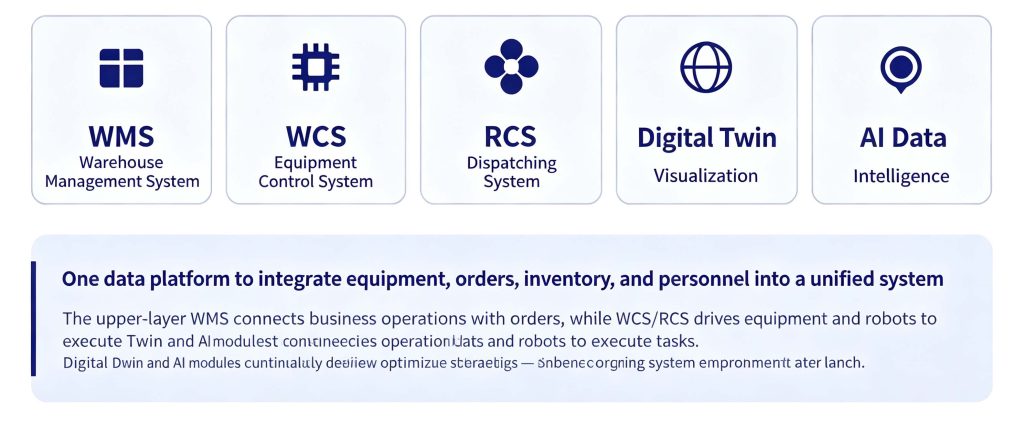
Hardware determines how much can be moved. Software determines whether the job is done right. We offer five software modules that work together on a shared data platform:
WMS – Warehouse Management — Connects business processes and orders, and manages inventory and warehouse operating strategies.
WCS – Equipment Control — Directly controls equipment on the warehouse floor.
RCS – Robot Scheduling — Coordinates routes and tasks across multiple robots to avoid congestion and deadlocks.
Digital Twin Visualization — Maps live operations onto a screen, making problems visible and allowing past events to be reviewed.
AI Data Intelligence — Uses operational data to optimize order waves, storage locations, and scheduling strategies.
The value of these five modules goes beyond their individual functions: they share the same data. Equipment status, order progress, inventory changes, and staff performance are connected within one system. Managers see one connected warehouse, rather than six isolated systems.
03 | Standardized Delivery in Six Steps: Turning Service Capabilities into Verifiable Milestones.
It’s easy to talk about service capabilities without showing what they mean in practice. We make them concrete through six delivery milestones, each with deliverables that can be reviewed and accepted.
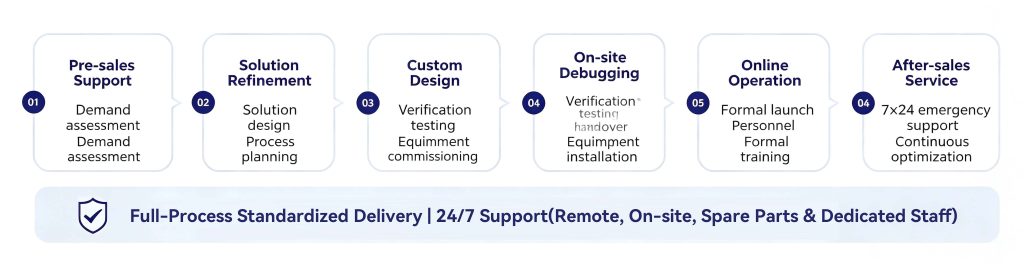
04 | After-Sales Support: The Real Test Comes Seven Days After Go-Live.
For many projects, the turning point comes after go-live. Rising volumes, changing SKU profiles, and equipment wear can gradually move a system away from the operating conditions it was originally designed for.
That’s why we commit to 24/7 support after go-live, backed by four services working in parallel.
Remote Support : We provide a 24/7 hotline and remote system access. Most software and scheduling issues can be diagnosed and resolved remotely, allowing a fast response without interrupting on-site operations.
On-Site Service : Our regional engineers provide support from nearby locations. When an issue requires on-site attention, they arrive within the agreed timeframe to address it in person, rather than stopping at telephone support.
Spare Parts Availability : Frequently used spare parts are stocked close to where they are needed. Equipment downtime means lost production capacity, and keeping spares nearby is the most effective way to shorten that downtime.
Resident Support : We provide resident operations and maintenance support for key projects. For high-volume projects with demanding requirements for continuous production, our engineers work alongside the customer’s team.
Beyond these services, we provide continuous optimization. We use operational data to review and refine scheduling strategies and workflows, helping the system run more smoothly in real-world use—rather than treating its go-live state as the endpoint.
05 | Credentials and Systems Behind Our Service.
Service capabilities need to be supported by established systems, rather than individual experience alone:
National High-Tech Enterprise Designation (China) — Technology leadership driven by innovation.
ISO 9001 Quality Management System Certification — Standardized delivery processes.
ISO 27001 Information Security Management System Certification — Security controls for customer data and systems.
20+ Software Copyrights — Core software developed and controlled in-house.
06 | Project Highlights: Results You Can Verify.
E-Commerce Platform · Rack-to-Person Solution
With 3,000 m² of storage space, storage efficiency improved fivefold, picking efficiency increased threefold, and picking accuracy reached 99.9%.
Pharmaceutical Group · Rack-to-Person Solution
100 AGVs work together to support deliveries to 1,287 stores, handling 10,000+ outbound order lines per day. The pharmaceutical industry demands the highest standards of accuracy and batch traceability, making this project a direct demonstration of the system’s reliability.
Automotive and Industrial Operations · Automated Forklifts + Elevated Smart Storage
Operational risk approached zero, workplace injury incidents fell by 99.9%, and operating efficiency increased by 50%. In operations involving heavy loads, handling at height, and continuous work, the value of replacing manual tasks with automation is especially clear.
The return on warehouse automation isn’t realized on the day the contract is signed, but during the first year of stable system operation.
We choose systems to fit each application, make the software work together, deliver through a standardized six-step process, and provide four layers of 24/7 after-sales support. This is the service foundation we’ve built through 100+ completed projects. Equipment can be bought, but the ability to deliver has to be built—one project at a time.
Evaluating a smart warehousing project?
Get in touch with our team. We can start by assessing your requirements and the project’s feasibility.