Home
HomeTop 5 Frequently Asked Questions About Overseas Project Delivery
 2026-08-11
 1705
1705
When equipment is sold overseas, customers have five recurring concerns. We address them directly through our real-world delivery practices. Two case studies from Thailand and Japan are included at the end.
Will you actually show up to install it once it’s shipped?
How do we handle those complex Japanese certifications?
How long does system integration take?
These are the most common questions our pre-sales and sales teams face. This article gets straight to the point to clear them up.
Q1: Once the equipment arrives on-site, who is responsible for installation?
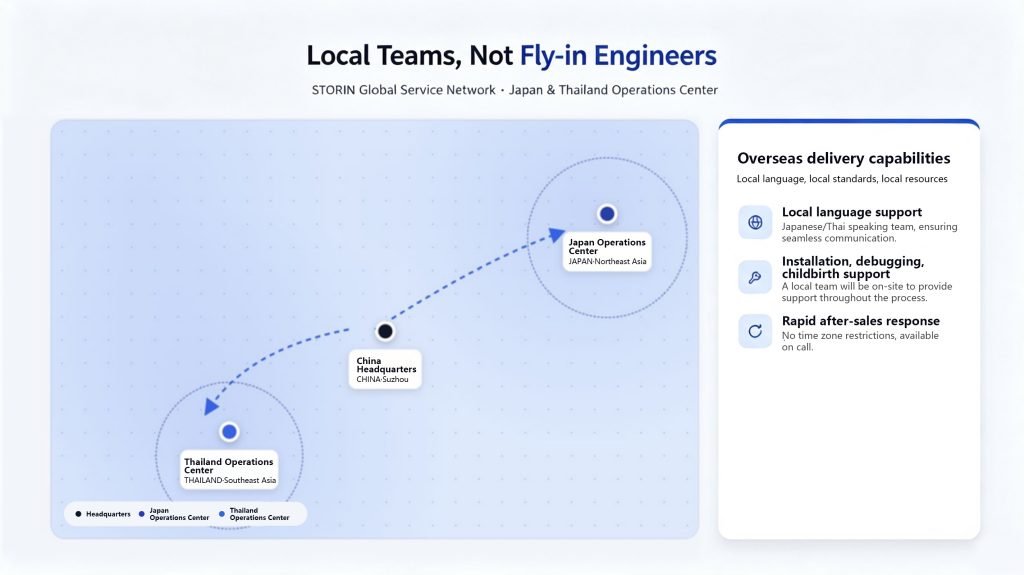
Local Teams, Not “Flying” Expats.
Dispatching engineers internationally is expensive and slow; time zone differences can cause simple on-site issues to drag on for days.
STORIN has operations centers in Japan and Thailand with teams already on the ground. They speak the local language, understand local standards, and take full responsibility for unloading, site entry, hardware assembly, and software deployment/commissioning.
We are neighbors, not just “foreign aid.”
Q2: Can we pass local certifications and compliance requirements?
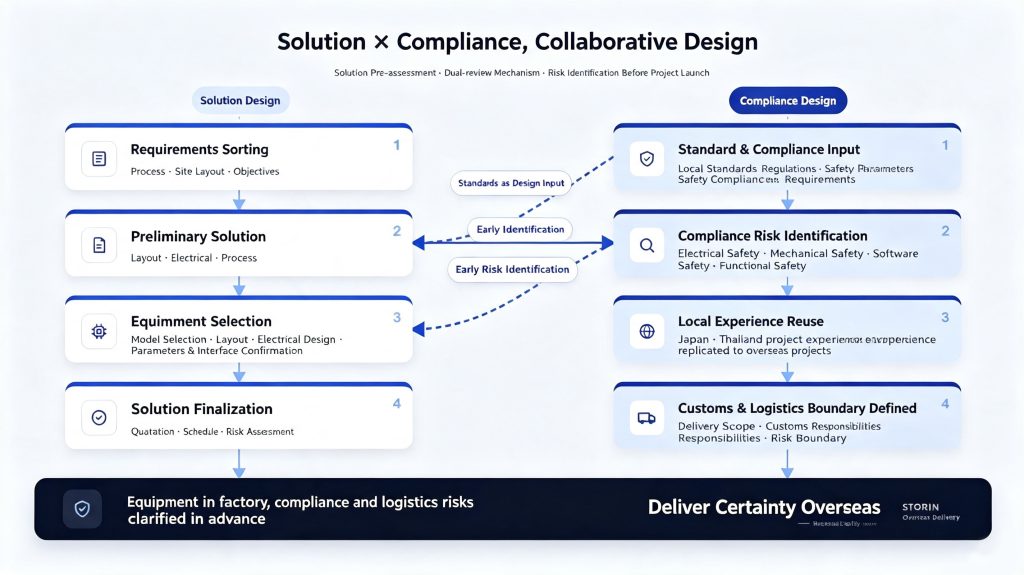
Standards Integrated as Inputs at the Design Stage
Regulations vary by country, such as JIS/PSE in Japan and various safety standards across Southeast Asia.
We don’t “wait for the equipment to be built” to check for certifications. During the solution design phase, we use these standards as design inputs and conduct simultaneous compliance pre-checks. Customs documentation and last-mile logistics are also planned in advance.
While the equipment is still in the factory, we have already navigated the potential pitfalls on behalf of the client.
Q3: How do you assess site conditions like power, flooring, and network?
Nailed Down at the Kick-off Meeting.
Within 72 hours of contract signing, we hold a Kick-off meeting to nail down three key areas:
Site conditions [floor plans, power/network, floor loading/levelness, throughput cycle], system boundaries [WMS/ERP versions, API interfaces, and responsibility mapping], and the milestone schedule [acceptance criteria and key dates].
Q4: Can the system interface with our existing WMS/ERP?
Fully Debugged Before Leaving the Factory.
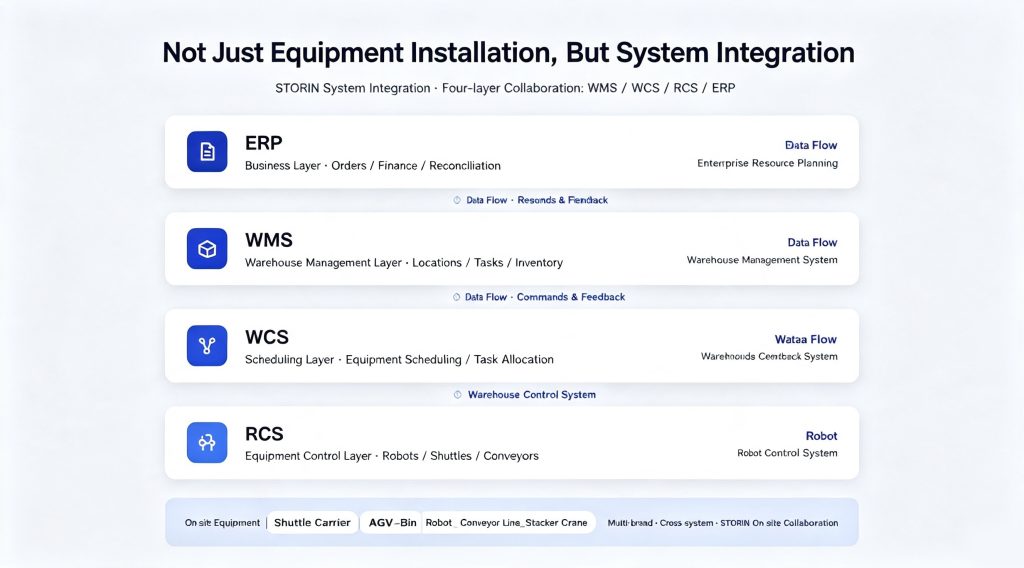
Equipment is just hardware; a warehouse requires the seamless orchestration of WMS, WCS, RCS, and ERP.
We perform pre-integration and simulation testing at the factory to resolve exception logic, such as network reconnection and timeout retries. Once on-site, the equipment is “plug-and-play.”
Q5: How long does the total delivery take? Will there be delays?
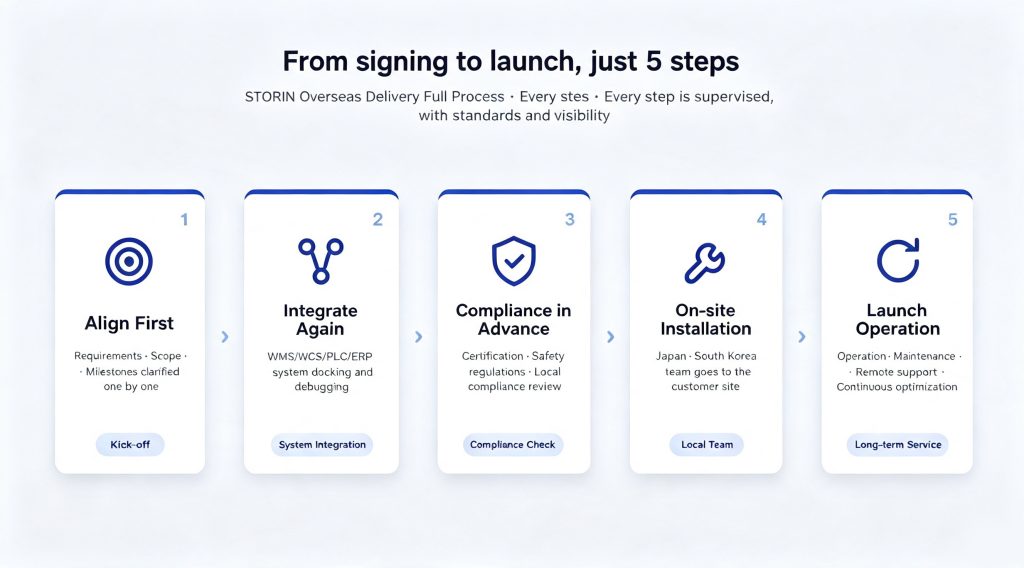
Controllable Milestones, Visible Progress.
Delivery is divided into five stages, each with a designated owner and acceptance criteria. Risks in customs and logistics are mitigated before shipment.
Clients don’t need to constantly ask “what’s the status?”—the progress is fully visible in the project schedule.
How fast is the response if an issue arises? — On-site go-live support + local after-sales service with native language support, available on-call.
Case Studies
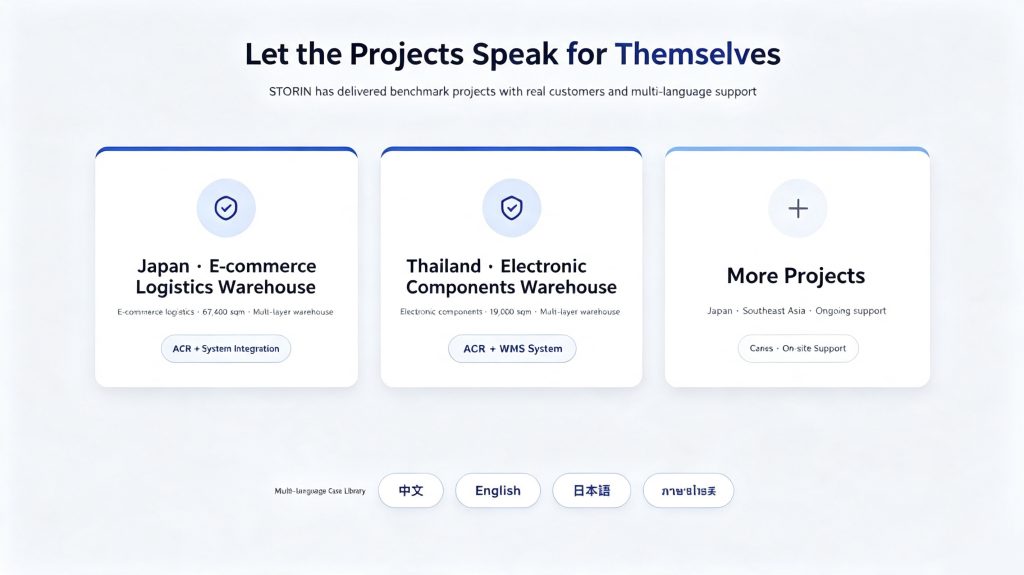
Thailand Project: Electronics Finished Goods Warehouse,17,820 Storage Locations, Seamless Implementation
Background: The client is a Thai electronics enterprise storing finished products such as smartphones and EV components.
Solution: Autonomous Case-handling Robot (ACR) system: 6 robots, 15-tier shelving, and 17,820 carton locations. Includes two conveyor workstations and automated palletizing at the outbound end.
Delivery: Compliance and customs were cleared before the equipment arrived at the port. The local team communicated in Thai and executed construction according to local standards.
Results: Go-live in approx. 4 months; order fulfillment efficiency increased 2x, and storage capacity grew by 50%.
Japan Project: E-commerce Logistics Warehouse,6,747 Bin Locations, Seamless Implementation
Background: The client is a Japanese e-commerce logistics firm focused on piece picking and high-volume return processing.
Solution: ACR system: 5 robots, 13-tier shelving, 6,747 bin locations, integrated with buffer shelving workstations and the ESS [Equipment Scheduling System].
Delivery: JIS/PSE certifications were pre-checked during design. The operations center is near Tokyo, allowing same-day engineer arrival.
Results: Go-live in 3-4 months; labor efficiency increased 2x, return-to-shelf cycles significantly shortened, and storage density increased by 50%.
Want to see the complete delivery process? Refer to our previous article, “The Equipment Contract is Signed, But the Real Delivery Has Only Just Begun.”
Conclusion
Our ultimate goal is to allow clients to envision the successful implementation of the project the moment the contract is signed.
Equipment determines if you can win a contract; delivery determines if you can achieve profitability and build a reputation.
💡 Planning an overseas warehousing project?
If you are grappling with these concerns, feel free to contact us via private message.