Home
HomeNew Car Models Every Day—Can Your Warehouse Keep Up? Smart Warehousing Solutions for Automotive Manufacturing
 2026-09-04
 1216
1216
Production Can’t Stop—Not Even for a Minute.
This is a core requirement of automotive logistics.Most automotive plants use JIT/JIS production. Parts must reach the line at the right time, in the right sequence.
Late — Line stops!
Wrong part — Line stops!!
Parts shortage — Line stops!!!
Many companies focus on production automation, but overlook one fact:
The production line is only the “last mile.” Warehousing and logistics are what keep it running.
Where It Started: 15 Minutes to Find Parts, Manual Delivery.
We worked with an auto parts factory facing very common challenges:
— Warehouse: 10,000+ SKUs, many small parts and specifications
— Receiving: Manual counting and paper records, causing inventory mismatches
— Line Feeding: Forklifts + manual work, taking 15 minutes on average to find parts
— Frequent Model Changes: Model A today, Model B tomorrow. One wrong sequence could stop the line.
The goal was simple: Deliver parts to the line on time, in sequence, and accurately.
The Solution: Not More Equipment, but a Smarter “Material Flow”.
The first step wasn’t choosing robots, but redesigning the entire material flow from start to finish.
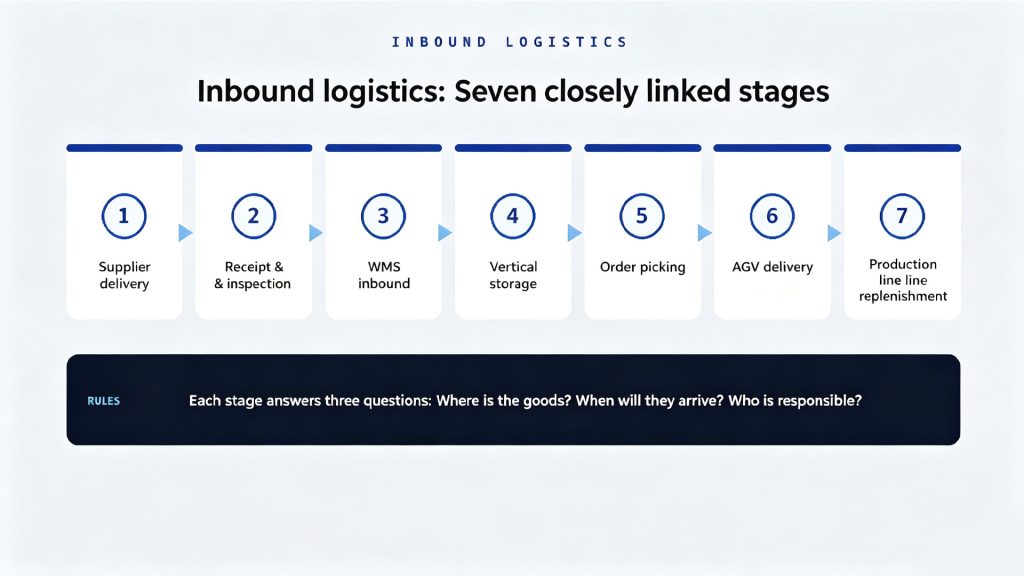
Across all 7 steps, we answer 3 questions: Where is it? When is it needed? Who is responsible?
— Storage: Bin robots handle small parts and multiple SKUs, utilizing over 5.5 m of vertical space and increasing storage density by 80%+. Pallets are handled by AS/RS with thousands of automated storage locations.
— Picking & Sequencing: SPS picking follows the production takt. One work order, one complete parts kit, ensuring the correct sequence.
— Delivery: AGVs deliver directly from the warehouse to the production line, cutting response time from hours to minutes.
— Software: WMS/WCS integrates with MES. The warehouse prepares exactly what the production line needs, with data connected end to end.
Results: Search Time Cut from 15 Minutes → 2 Minutes.
After implementation, these numbers show the impact most clearly (illustrative data).
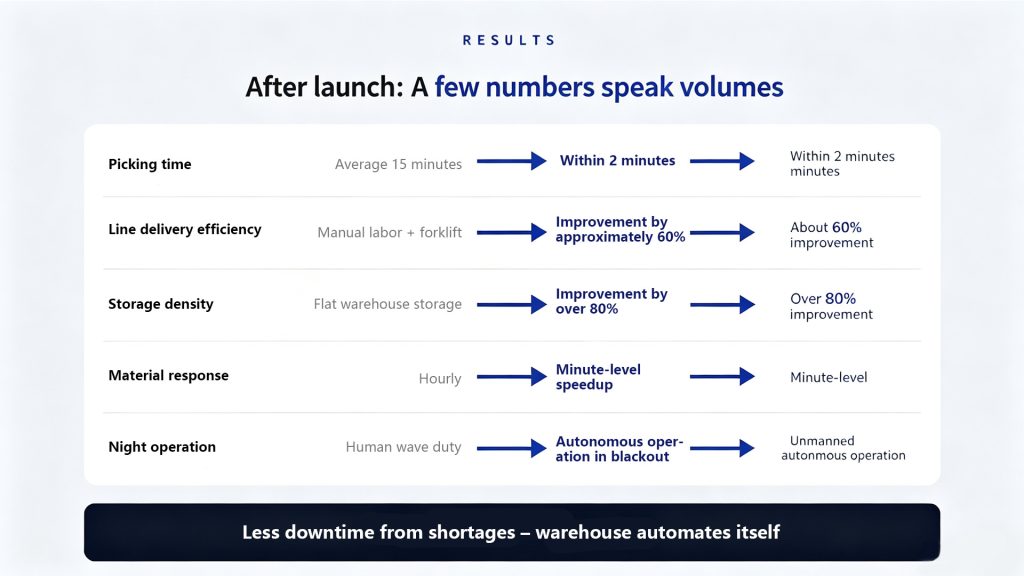
More importantly, line stoppages caused by material shortages dropped significantly.
The customer said, We used to dread late-night calls. Now, the warehouse runs itself.
Why Us: Service Capability Isn’t a PPT — It’s a Proven Process.
This project succeeded not just because of the equipment, but because of our 4-step service capability:
1. Scenario Analysis: Understand the SKUs, takt time, and site conditions before designing the solution.
2. Solution Selection: Match bin robots, AGVs, shuttles, and AS/RS to the actual material flow.
3. Pre-integration & Simulation: Test and simulate the system before shipment to minimize on-site rework.
4. Local Delivery & Ramp-up Support: Control every milestone from contract to go-live, with local teams providing on-site support.
Equipment is just the components. The real value is a system that works.
Our job is to make the entire system truly work in your factory.
💡 Planning a Smart Warehouse for Automotive Manufacturing?
Contact STORIN for an Automotive Parts Warehousing & Logistics Feasibility Assessment
We help you evaluate materials · takt time · space · systems all at once.
STORIN · Smart Warehouse System Integrator.
Making smart warehouse transformation and global expansion easier.