Home
HomeSix Steps to a Smart Warehouse: From Consultation and Planning to 24/7 Support
 2026-10-10
 4
4
100+ projects implemented, 63,000 m² of warehouse space delivered, six key application areas, and service coverage across five regions worldwide — STORIN combines a standardized delivery process with four layers of after-sales support to bring warehouse automation to life.
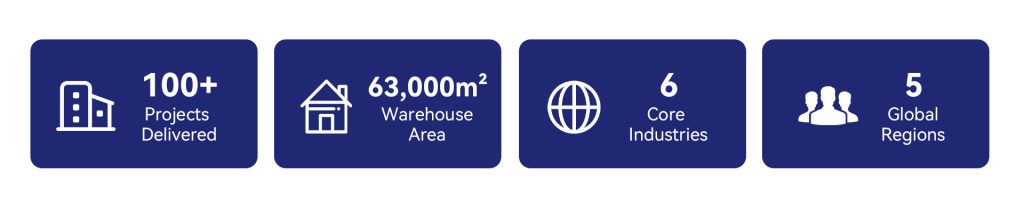
STORIN is a smart warehousing systems integrator, providing end-to-end services from consultation and planning to system delivery. To date, we have helped implement 100+ projects and managed more than 63,000 m² of warehouse space, serving six core industries across five regions worldwide.
Across the industry, the same problem keeps coming up: the equipment has been purchased, but the system still isn’t working.
Equipment specifications clearly state how much an AGV can carry, how fast a shuttle can move, and how high the racking is. But the success of a smart warehousing project often depends on how well the integrator can deliver the project and support it over the long term. Does the solution meet real operational needs? Can the systems connect and work together? And who will take responsibility seven days—or 100 days—after the system goes live?
In this article, we’ll explain how we meet different application needs, support project delivery, and provide after-sales service.
01 | Six Key Applications: From Automating Individual Tasks to a Fully Integrated Smart Warehouse.
Smart warehousing isn’t a one-size-fits-all solution. E-commerce, pharmaceuticals, automotive and industrial operations, and electronics manufacturing all have different SKU profiles, order processing waves, site conditions, and staffing structures. That’s why we don’t offer the same solution to every customer. We start with how each warehouse will actually be used, then select the right combination of systems and equipment to meet its needs.
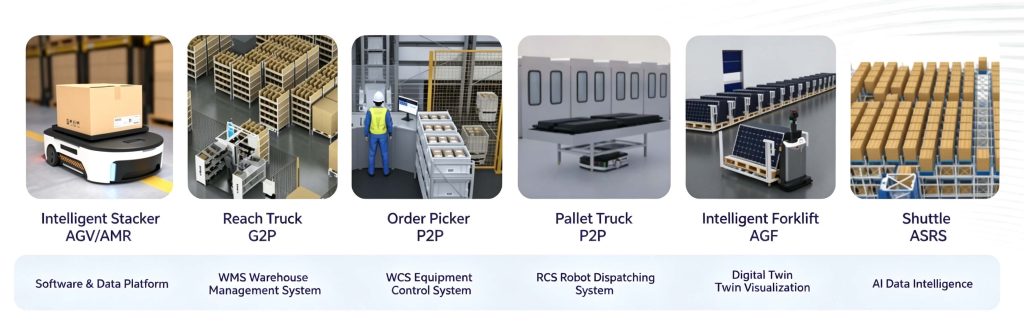
1. Intelligent Material Handling: AGV / AMR
Mobile robots—including underride, tote-handling, and forklift models—take over manual transport and move goods between different areas. They suit operations with frequent transport tasks and relatively fixed routes. This is one of the most common starting points for warehouse automation, offering manageable investment and clear results.
2. Goods-to-Person: G2P
Robots lift or transport entire racks to picking workstations, bringing goods to operators rather than making operators walk to the goods. Well suited to e-commerce and retail warehouses with many SKUs and fragmented orders, this approach delivers some of the most noticeable gains in picking efficiency.
3. Bin-to-Person: B2P
Robots use storage totes as the handling unit, bringing the required tote to a workstation. This approach suits operations with a wide variety of products, small batches, and high-density tote storage, balancing storage efficiency with picking efficiency.
4. Pallet-to-Person: P2P
Goods are handled by the pallet, with conveyor systems bringing full pallet loads to workstations. This approach suits distribution warehouses that ship full cases and handle large inbound and outbound volumes.
5. Automated Forklifts: AGF
Driverless forklifts handle pallet transport, put-away, and truck loading and unloading, replacing manual operation in tasks involving lifting at height and moving heavy loads. They are particularly useful in cold or dusty environments that are unsuitable for prolonged manual work.
6. Shuttle-Based ASRS
Four-way shuttles work with multi-level racking to create a high-density automated storage and retrieval system, maximizing storage capacity within a limited footprint. This approach suits projects that require both efficient use of floor space and high throughput.
02 | Software and Data Platform: Making Equipment Work Together.
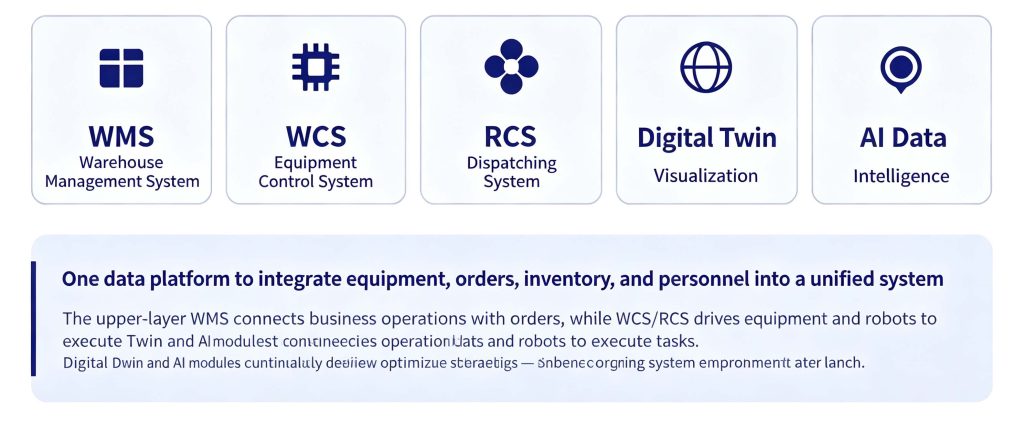
Hardware determines how much can be moved. Software determines whether the job is done right. We offer five software modules that work together on a shared data platform:
WMS – Warehouse Management — Connects business processes and orders, and manages inventory and warehouse operating strategies.
WCS – Equipment Control — Directly controls equipment on the warehouse floor.
RCS – Robot Scheduling — Coordinates routes and tasks across multiple robots to avoid congestion and deadlocks.
Digital Twin Visualization — Maps live operations onto a screen, making problems visible and allowing past events to be reviewed.
AI Data Intelligence — Uses operational data to optimize order waves, storage locations, and scheduling strategies.
The value of these five modules goes beyond their individual functions: they share the same data. Equipment status, order progress, inventory changes, and staff performance are connected within one system. Managers see one connected warehouse, rather than six isolated systems.
03 | Standardized Delivery in Six Steps: Turning Service Capabilities into Verifiable Milestones.
It’s easy to talk about service capabilities without showing what they mean in practice. We make them concrete through six delivery milestones, each with deliverables that can be reviewed and accepted.
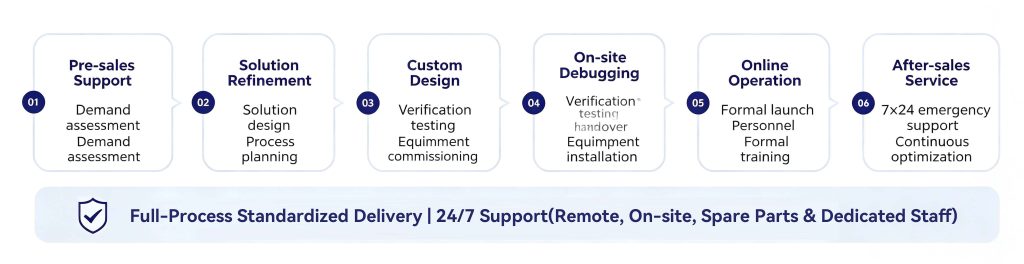
04 | After-Sales Support: The Real Test Comes Seven Days After Go-Live.
For many projects, the turning point comes after go-live. Rising volumes, changing SKU profiles, and equipment wear can gradually move a system away from the operating conditions it was originally designed for.
That’s why we commit to 24/7 support after go-live, backed by four services working in parallel.
Remote Support : We provide a 24/7 hotline and remote system access. Most software and scheduling issues can be diagnosed and resolved remotely, allowing a fast response without interrupting on-site operations.
On-Site Service : Our regional engineers provide support from nearby locations. When an issue requires on-site attention, they arrive within the agreed timeframe to address it in person, rather than stopping at telephone support.
Spare Parts Availability : Frequently used spare parts are stocked close to where they are needed. Equipment downtime means lost production capacity, and keeping spares nearby is the most effective way to shorten that downtime.
Resident Support : We provide resident operations and maintenance support for key projects. For high-volume projects with demanding requirements for continuous production, our engineers work alongside the customer’s team.
Beyond these services, we provide continuous optimization. We use operational data to review and refine scheduling strategies and workflows, helping the system run more smoothly in real-world use—rather than treating its go-live state as the endpoint.
05 | Credentials and Systems Behind Our Service.
Service capabilities need to be supported by established systems, rather than individual experience alone:
National High-Tech Enterprise Designation (China) — Technology leadership driven by innovation.
ISO 9001 Quality Management System Certification — Standardized delivery processes.
ISO 27001 Information Security Management System Certification — Security controls for customer data and systems.
20+ Software Copyrights — Core software developed and controlled in-house.
06 | Project Highlights: Results You Can Verify.
E-Commerce Platform · Rack-to-Person Solution
With 3,000 m² of storage space, storage efficiency improved fivefold, picking efficiency increased threefold, and picking accuracy reached 99.9%.
Pharmaceutical Group · Rack-to-Person Solution
100 AGVs work together to support deliveries to 1,287 stores, handling 10,000+ outbound order lines per day. The pharmaceutical industry demands the highest standards of accuracy and batch traceability, making this project a direct demonstration of the system’s reliability.
Automotive and Industrial Operations · Automated Forklifts + Elevated Smart Storage
Operational risk approached zero, workplace injury incidents fell by 99.9%, and operating efficiency increased by 50%. In operations involving heavy loads, handling at height, and continuous work, the value of replacing manual tasks with automation is especially clear.
The return on warehouse automation isn’t realized on the day the contract is signed, but during the first year of stable system operation.
We choose systems to fit each application, make the software work together, deliver through a standardized six-step process, and provide four layers of 24/7 after-sales support. This is the service foundation we’ve built through 100+ completed projects. Equipment can be bought, but the ability to deliver has to be built—one project at a time.
Evaluating a smart warehousing project?
Get in touch with our team. We can start by assessing your requirements and the project’s feasibility.