Home
HomeGlobal Warehouse Automation Trends: What’s Driving the Urgency?
 2026-08-28
 1230
1230
Understand the Trends Before Expanding into Global Markets.
Faster markets Fewer workers Smaller goods Three shifts happening at once.
“Should we wait a bit longer for warehouse automation?” Many companies planning to go global are waiting for the “right time.”
But CeMAT ASIA 2025 showed a different reality: the right time isn’t something you wait for — the market is pushing you toward it.
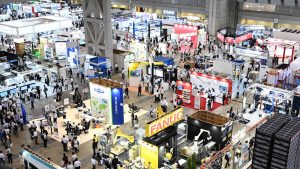
This exhibition—Asia’s largest logistics show with 1,000 exhibitors and 150,000 visitors—showed that overseas buyers aren’t just spectators. They are no longer talking about “importing equipment” but want to transplant entire solutions to their own countries.
What’s driving the urgency for warehouse automation worldwide? Three major shifts are happening at once.
Markets Are Accelerating: It’s No Longer About Whether to Automate — Move Too Slowly, and You’ll Fall Behind.
Here are some numbers worth noting:
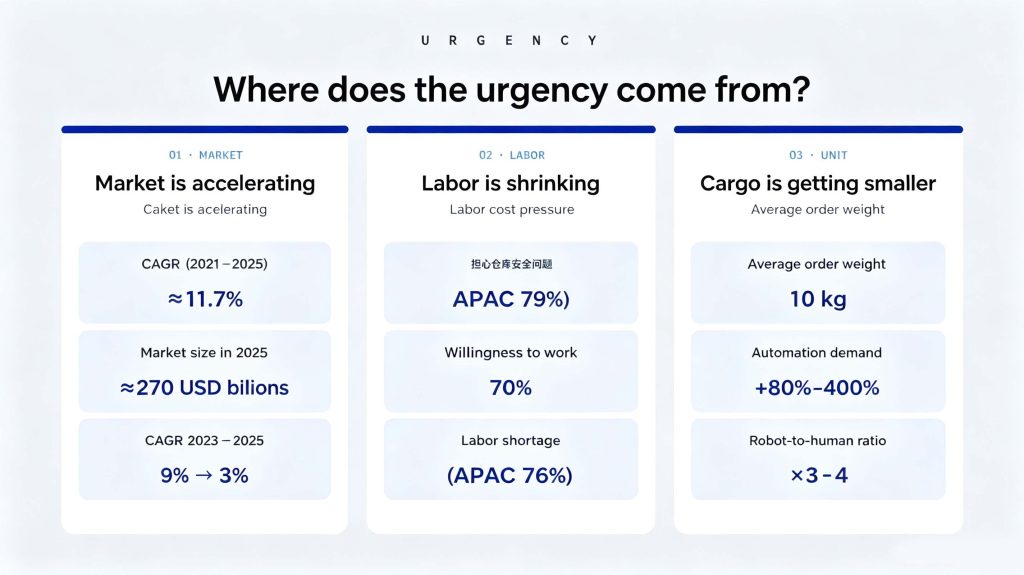
— Market Growth: From 2019 to 2025, the global warehouse automation market grew at a CAGR of approximately 11.7%, reaching around US$27 billion in 2025.
— Nearly Doubled: According to Research and Markets, the automated warehousing market is projected to grow from US$17.25 billion in 2024 to US$40.32 billion by 2030.
— Fewer Companies Are Waiting: The share of companies with no warehouse automation dropped from 9% in 2023 to just 3% in 2025.
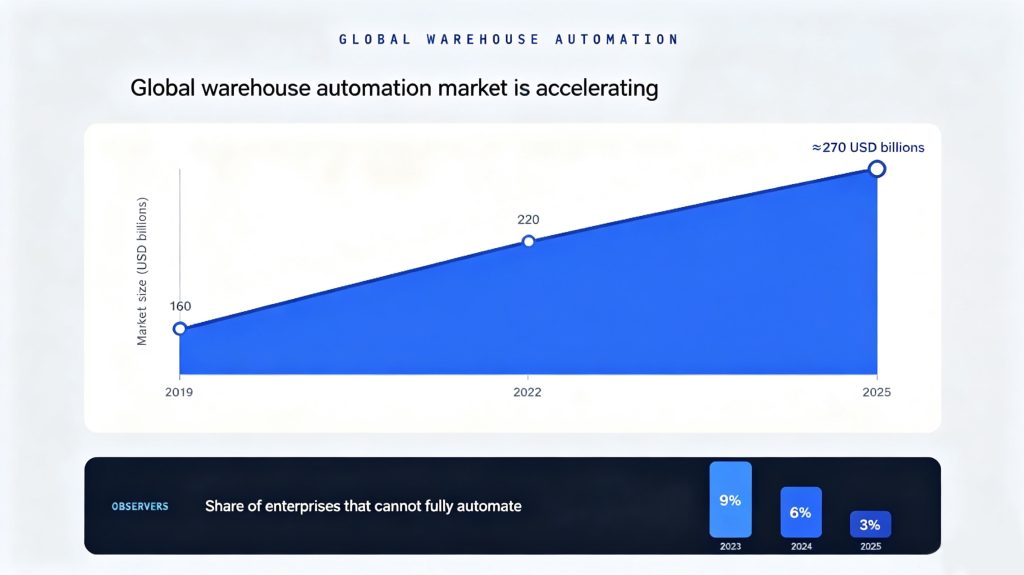
“Waiting and watching” is becoming the minority. By the time you decide to act, your competitors may already have gained an edge in cost efficiency and delivery speed.
Labor is Decreasing: It’s becoming harder and harder to find “people” for the warehouse.
Another sense of urgency comes from the inability to recruit staff.
Zebra industry research shows: 72% of warehouse managers worry about safety (79% in Asia-Pacific), 70% worry about injury risks, and 69% worry about insufficient certification and operator fatigue (76% in Asia-Pacific).
In key overseas markets like Japan and Southeast Asia, hiring and retaining workers is no longer a short-term challenge — it’s a structural trend. Automation is no longer about “whether to adopt it,” but “how to use it to bridge the labor gap.”
Goods are Getting Smaller: E-commerce has rewritten the entire logic of the warehouse.
In the past, warehouses moved pallets weighing hundreds of kilograms. But e-commerce has split single items smaller and smaller—the average weight of a single item has dropped to just over ten kilograms.
Pallets are being replaced by totes in many processes, leading to the emergence of case-handling robots. The most crowded exhibition area at CeMAT 2025 featured case-handling robots: storage density increased by 80%–400%, labor efficiency improved by 3–4 times, and warehouse automation transformation can be completed within a week.
As the granularity of goods changes, warehousing technology must adapt. This is not a trend forecast, but a reality currently taking place. With these three forces combined, the urgency is crystal clear.
Opportunity Window: China’s warehouse automation is currently [Leading].
Beyond the urgency, there is good news.
The consensus at CeMAT 2025 is that Chinese Logistics Technology (LogisTech) has moved from “following” to “leading” — gaining international discourse power in multiple categories, from case-handling robots and four-way shuttles to flying-box systems.
— Fastest Iteration: Chinese products move from R&D to production in 6 months or less, a speed rarely seen globally.
— Global Launching Pad: China has become the world’s largest application market for LogisTech and a primary starting point for global expansion.
— Higher Profits: Pioneers have proven that profits in overseas markets often far exceed those in domestic markets.
For companies planning overseas warehouses, this means you no longer need to wait for “technology to mature” — the technology is in China, the maturity is sufficient, and the real issue is “how to implement it stably.”
STORIN: Trends belong to others, but implementation belongs to you.
Understanding the trend is only the first step. Whether the equipment can pass local certification, whether the system can integrate with the customer’s WMS, whether there are people on-site to install it, and whether there is support after installation — these are the keys to turning a “trend” into “profit.”
STORIN provides intelligent warehouse system integration, with operations centers and local teams in Japan and Thailand. We use five stages to make overseas delivery controllable: Signing & Alignment → Compliance & Solution Design → Pre-integration & Simulation → Local Installation & Commissioning → Go-live Support & Continuous Maintenance.
While equipment is still in the factory, compliance and logistics risks are cleared in advance. You focus on selling products, and we ensure the equipment is implemented stably.
💡 Planning a warehouse automation project in Japan or Southeast Asia?
Contact us via DM. The STORIN team can provide a free feasibility assessment for overseas warehouse automation.
Free Feasibility Assessment for Overseas Warehouse Automation.
Helping you clarify local compliance, site conditions, and system integration all at once.
STORIN · Intelligent Warehousing System Integrator — Making global warehouse intelligence upgrades and expansion easier!