
PROJECT BACKGROUND
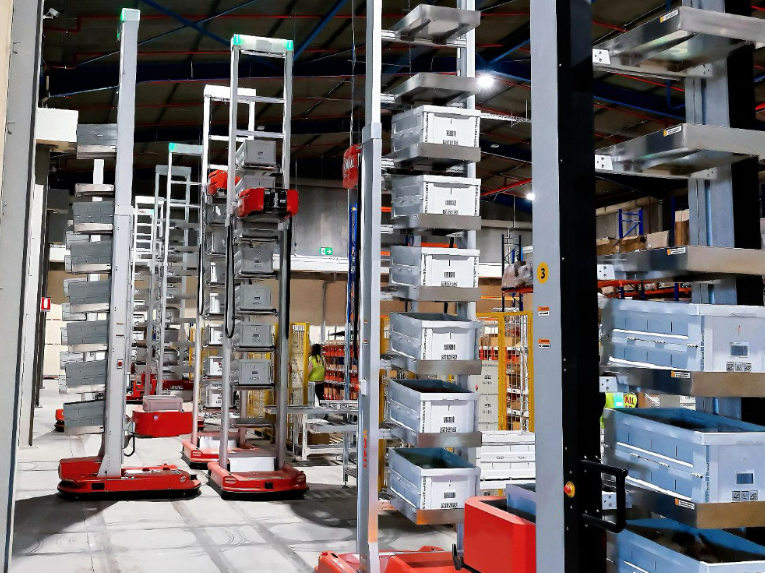
3,300㎡ storage space
Conveyor line operating capacity
Cache shelf operation capabilities
Picking accuracy
Project Pain Points
Human Resources Challenges: The Australian market presents significant challenges in acquiring labor, and employee turnover is high.
Operational Efficiency Bottlenecks: Traditional manual picking processes are inefficient and have a high error rate.
Storage Space Limitations: The existing warehouse has a height of 8.5 meters, but traditional storage solutions fail to effectively utilize vertical space, resulting in low storage density.
Solution
We customized and deployed an advanced intelligent automated warehousing system for this Sydney distribution center:
Robot Configuration:
13 A42 robots (standard type)
7 A42T robots (specific function type, can be specified based on specific circumstances)
Workstation Design: 5 single-U conveyor workstations to optimize material flow and picking operations.
Rack System: Rack height designed at 7.9 meters to maximize vertical storage.
Bin Standard: Uniform bin size of 600mm (L) x 400mm (W) x 320mm (H).
Customer Value
High-Density Storage Capacity: Fully utilizing the 7.9-meter vertical space within warehouse clearance and fire safety requirements, achieving a storage capacity of 11,000 boxes, significantly improving space utilization.
Multi-Temperature Picking Optimization: Innovatively introducing a mobile picking cart combined with an electronic tagging system, efficiently and economically solving the relay picking challenges of multi-temperature products including dry goods, fresh produce, and frozen goods.
Electronic tagging systems significantly reduce the error rate of manual picking.
The “goods-to-person” picking model greatly improves the picking efficiency of operators.
Operational efficiency indicators: Single-station picking efficiency: 168 items/hour.
Daily outbound efficiency: 8,000 items/day.